
History of Borussia Dortmund FC
The history of Borussia Dortmund FC dates back to 1909. It was founded on December 19, 1909, in Dortmund, Germany. The club’s roots lie in a group of young men from the Trinity Youth Club at a local Catholic church. These 18 football enthusiasts, frustrated with the restrictive oversight of their priest, Father Dewald, decided to establish their own football team. They met at a pub called Zum Wildschütz to formalize the creation of the club, choosing the name “Borussia,” inspired by a local brewery with the same name.
Early Years and Struggles
In its formative years, Borussia Dortmund played in blue and white striped jerseys with a red sash, a far cry from their now-iconic black and yellow colors. The team struggled financially and athletically, competing in regional leagues without significant success. By the 1920s, the club transitioned to the black and yellow kit, symbolizing its growing identity.
Financial troubles plagued the club in its early decades. World War I and the Great Depression heavily impacted Dortmund, both economically and socially. However, a dedicated fanbase and the passion of its players helped the team survive.
Post-War Revival and Success
After World War II, Dortmund became a symbol of hope for the local population. The club’s home city of Dortmund, located in the industrial Ruhr region, was severely affected by the war. Football provided a sense of unity and pride, and Borussia Dortmund played a crucial role in the community’s revival.
In 1956 and 1957, Borussia Dortmund won their first German championships, marking their arrival as a force in German football. Their success continued into the 1960s, with their most notable achievement being their victory in the 1966 European Cup Winners’ Cup, making them the first German team to win a European competition.
Modern Era and Challenges
In the 1990s, under coach Ottmar Hitzfeld, Borussia Dortmund reached new heights, winning back-to-back Bundesliga titles in 1995 and 1996. This era was capped by their 1997 UEFA Champions League triumph, where they defeated Juventus 3-1 in a historic final.
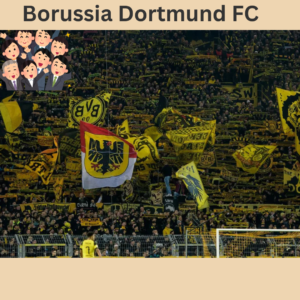
Financial difficulties in the early 2000s nearly led to bankruptcy, but the club’s management and fanbase rallied to save it. Today, Borussia Dortmund is one of the most successful and well-supported clubs in the world, renowned for their attacking football, youth development, and the iconic Signal Iduna Park, home to the famous “Yellow Wall.”
Through resilience and passion, BVB has grown into a footballing powerhouse, symbolizing the spirit of Dortmund and its people.
15 interesting facts about Borussia Dortmund FC
- The Name “Borussia” Came from a Brewery
The club’s name, “Borussia,” was inspired by the Borussia Brewery, a popular local beer maker in Dortmund at the time of the club’s founding in 1909. The name reflects a common regional pride rather than any direct connection to the brewery. - Record-Breaking Attendance
Borussia Dortmund’s home ground, Signal Iduna Park, is the largest stadium in Germany, with a capacity of over 81,000 fans. Its “Yellow Wall”, the South Stand, is the largest terrace for standing spectators in European football, capable of holding more than 24,000 fans. - First German Club to Win a European Trophy
In 1966, Borussia Dortmund became the first German club to win a European competition by defeating Liverpool 2-1 in the European Cup Winners’ Cup final, setting a precedent for German football in Europe. - The Black and Yellow Kit Wasn’t the Original
Borussia Dortmund originally played in blue and white striped jerseys with a red sash. They switched to their iconic black and yellow colors in the 1920s, which now symbolize the club and its identity. - The Rescue from Bankruptcy
In the early 2000s, Borussia Dortmund faced severe financial difficulties, nearly going bankrupt. Rivals Bayern Munich loaned them €2 million without interest to help them stay afloat, showing a rare act of camaraderie in football. - The Famous “You’ll Never Walk Alone” Chant
Dortmund fans are known for passionately singing “You’ll Never Walk Alone” before matches. While this tradition is often associated with Liverpool, Dortmund fans embraced it as a symbol of unity and strength during the club’s tough times. - Fan Ownership and Democratic Values
Borussia Dortmund adheres to Germany’s 50+1 ownership rule, ensuring fans have a controlling stake in the club. This structure gives fans significant influence over decisions, preserving the club’s community-focused ethos. - World Record Transfer
In 2017, Borussia Dortmund sold Ousmane Dembélé to Barcelona for €105 million, marking one of the highest transfer fees in football history. The deal included performance-related add-ons, making it even more lucrative. - A Commitment to Youth Development
Dortmund has a stellar reputation for developing young talents, including players like Marco Reus, Robert Lewandowski, Mario Götze, and Jadon Sancho. Their academy and scouting network are among the best in Europe. - The BVB 09 Nickname Explained
The “09” in the club’s full name stands for 1909, the year of its founding. “BVB” comes from the club’s German name, Ballspielverein Borussia, meaning “Borussia Ball Game Club.” - The Signal Iduna Park Electricity Generator
The club’s home stadium has its own solar power plant installed on the roof, reflecting Borussia Dortmund’s commitment to environmental sustainability. - Dortmund’s Connection with the Ruhr Region
Borussia Dortmund represents the working-class Ruhr area, historically known for its coal mining and industrial heritage. The club embodies the spirit of hard work and perseverance, resonating deeply with its local fanbase. - The Rivalry with Schalke
Borussia Dortmund’s rivalry with FC Schalke 04, known as the Revierderby, is one of the fiercest in world football. The rivalry stems from the clubs’ close proximity in the Ruhr region, separated by just 32 kilometers. - Record Champions League Attendance
In 2013, during the Champions League quarter-final match against Malaga, Borussia Dortmund fans set a record for stadium attendance noise, with the decibel level reportedly exceeding 120 dB. - The Passionate Ultras
Dortmund’s ultras are famous for their elaborate tifos and banners, which often cover the entire South Stand. Their creative displays make Signal Iduna Park a fortress and an intimidating venue for visiting teams.
These facts highlight Borussia Dortmund’s rich history, vibrant culture, and immense influence both in German and international football.