
History of Atlético Madrid FC
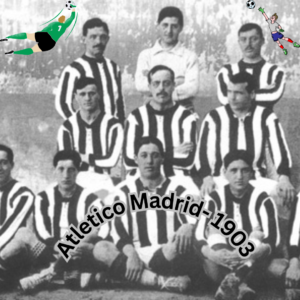
The history of Atlético Madrid FC was founded on April 26, 1903, in the Spanish capital. The club’s origins trace back to three Basque students living in Madrid, who envisioned a team that could represent their Basque heritage while competing in the growing world of football. Initially named Athletic Club de Madrid, the club was established as a branch of the Athletic Club of Bilbao, one of Spain’s oldest football institutions.
Early Years and Independence
In its formative years, Atlético Madrid adopted blue and white as its colors, mirroring its parent club, Athletic Bilbao. The team played in various local competitions but lacked a permanent home. In 1911, both Athletic Madrid and Athletic Bilbao switched to red and white striped jerseys, inspired by the availability and affordability of cloth from mattresses—a decision that earned Atlético the nickname “Los Colchoneros” (The Mattress Makers).
Atlético Madrid officially separated from Athletic Bilbao in 1921, becoming an independent entity. The club’s first official ground was the Estadio Metropolitano, which they inaugurated in 1923.
Joining La Liga
When La Liga, Spain’s professional football league, was established in 1929, Atlético Madrid was one of the ten founding clubs. Although initially struggling to compete with larger teams like Real Madrid and Barcelona, the club steadily grew in stature.
Civil War and Transformation
The Spanish Civil War (1936–1939) temporarily halted professional football. In 1939, Atlético merged with Aviación Nacional, the Spanish Air Force football team, and became known as Athletic Aviación Club. This partnership provided financial and logistical support, helping Atlético win its first La Liga titles in 1940 and 1941.
By 1947, the club had reverted to its original name, Club Atlético de Madrid, and continued building its reputation. The team moved to the Vicente Calderón Stadium in 1966, which became its iconic home for decades.
Modern Success
Atlético Madrid has since become one of Spain’s most successful clubs, winning La Liga titles, Copa del Rey, and international trophies like the UEFA Europa League. Under manager Diego Simeone, the club reached new heights in the 2010s, competing consistently in the UEFA Champions League and challenging Europe’s top teams.
Today, Atlético Madrid is celebrated for its passionate fanbase, resilience, and strong identity as a working-class club, symbolizing determination and grit in Spanish football.
15 interesting facts about Atlético Madrid FC
- The Basque Connection
Atlético Madrid was originally established as a branch of Athletic Club Bilbao in 1903. The founders were three Basque students who wanted a club in Madrid to represent their region. This connection influenced Atlético’s early culture and traditions. - The Mattress Maker Nickname
Atlético’s iconic red-and-white striped jerseys originated from a cost-saving decision. The club purchased leftover mattress fabric for their kits, earning them the nickname “Los Colchoneros” (The Mattress Makers), which persists to this day. - The Forgotten Merger
After the Spanish Civil War, Atlético merged with Aviación Nacional, a team representing the Spanish Air Force, in 1939. For several years, they were called Athletic Aviación Club and even adopted the Air Force’s logo before reverting to their original name in 1947. - La Liga Founding Member
Atlético Madrid was one of the ten founding members of La Liga in 1929. Despite this, they spent several seasons in the lower divisions during their early years before becoming a consistent top-flight competitor. - The Vicente Calderón Stadium Legacy
For over 50 years, Vicente Calderón Stadium was the heart of Atlético Madrid. It was unique for having a highway run directly underneath one of its stands, making it a one-of-a-kind football venue. - Diego Simeone’s Dual Legacy
Diego Simeone, one of Atlético’s most celebrated managers, also had a successful playing career at the club. As a midfielder, he helped Atlético secure a historic La Liga and Copa del Rey double in the 1995-96 season. - The Curse of the European Cup Final
Atlético Madrid has reached the UEFA Champions League final three times (1974, 2014, 2016) but has never won. Each defeat was heartbreakingly close, with two losses coming at the hands of city rivals Real Madrid. - The Bear and Strawberry Tree Crest
The club’s crest features El Oso y El Madroño (the bear and strawberry tree), a symbol from Madrid’s coat of arms. This represents Atlético’s deep connection to the city and its heritage. - Unrivalled Rivalry with Real Madrid
The Madrid derby between Atlético and Real Madrid is one of the fiercest in football. Unlike Real Madrid, known for wealth and prestige, Atlético is often seen as representing the working class, giving the rivalry a socio-economic dimension. - The Wanda Metropolitano Innovation
Atlético moved to the Wanda Metropolitano Stadium in 2017, a state-of-the-art facility with one of the highest seating capacities in Spain. It was also the venue for the 2019 UEFA Champions League final, which Atlético fans hope foreshadows their future triumphs in the competition. - Rojiblancos’ European Success
While they’ve struggled in the Champions League, Atlético has found immense success in the Europa League, winning it in 2010, 2012, and 2018. These triumphs established their reputation as one of Europe’s most resilient clubs. - A Club of Firsts
Atlético was the first Spanish team to tour Latin America in 1928, playing matches in Argentina, Uruguay, and Peru. This tour helped establish their reputation beyond Europe. - Atlético’s Fan-Owned Era
For much of its history, Atlético was owned and operated by its members, known as socios. This changed in the early 1990s when majority ownership shifted to private hands. - Women’s Team Success
Atlético Madrid’s women’s team has been equally successful, winning multiple Primera División Femenina titles and growing rapidly in popularity. - Community Focus
Atlético runs extensive community programs, including youth academies and social initiatives, underscoring their role as a club deeply rooted in their community.
From its early Basque roots to its modern success under Diego Simeone, Atlético Madrid embodies resilience, passion, and an underdog spirit that makes it one of the most iconic clubs in world football.